Content

Exploring Avian Wonders of Malaysia


The avian landscape of Malaysia is a masterpiece of evolutionary design, boasting a verified eBird checklist of approximately 860 species as of 2026. This extraordinary biodiversity is a primary draw for nature photography and birdwatching tours in Southeast Asia, shaped by the country's unique position across two distinct landmasses: the Asian mainland and the equatorial island of Borneo. In Peninsular Malaysia, 684 species have been recorded, making it a premier destination for spotting continental birds moving south through the East Asian-Australasian Flyway. Key hotspots like Fraser’s Hill, Kuala Selangor, and the ancient rainforests of Taman Negara offer world-class sightings of both resident and migratory species. Across the South China Sea, Malaysian Borneo (Sabah and Sarawak) hosts 681 species. While the species totals are similar to the peninsula, Borneo is a global epicenter for endemism. Regions like Danum Valley and the Kinabatangan River shelter birds that evolved in isolation and are found nowhere else on the planet, including the famed Bornean Bristlehead.

This vast population is categorized by seasonal habits, with roughly 610 resident birds serving as permanent inhabitants that breed in the tropical rainforests year-round. They are joined by about 250 migratory species that travel along the East Asian-Australasian Flyway, seeking refuge in Malaysia’s equatorial climate during the northern winter months. Among the most sought-after inhabitants for wildlife photographers are the 10 species of Hornbills, including the majestic Rhinoceros Hornbill, which share the high canopy with 16 species of Barbets that provide the rhythmic soundtrack to the jungle. The social Broadbills, with 8 species known for their vibrant colors and oversized heads, build elaborate hanging nests over forest streams.

Central to this heritage are the hornbills, which hold a profound status in Malaysian culture. While Peninsular Malaysia supports all 10 recorded species (including the Great Hornbill and Plain-pouched Hornbill found in the northern belts), Malaysian Borneo is home to 8 species. In Sarawak, famously known as the "Land of the Hornbills" or Bumi Kenyalang, these birds are revered as sacred messengers. The Iban people celebrate the Gawai Kenyalang (Hornbill Festival), traditionally a ceremony to invite the spirits to a feast. The Rhinoceros Hornbill, as the state bird, symbolizes power and purity, with its image etched into everything from traditional wood carvings to modern architecture.

Ecologically, hornbills are the indispensable "Farmers of the Forest." While they are often categorized as frugivores—specifically favoring figs (Ficus)—they are actually opportunistic omnivores. To sustain their massive bodies and provide high-protein meals for their young, they supplement their fruit diet with lizards, frogs, snakes, insects, and even the eggs or nestlings of other birds. As they fly vast distances across the canopy, they disperse large seeds that smaller birds cannot swallow, ensuring the regeneration of the primary rainforest.

Their survival is anchored to their unique status as obligate cavity nesters. Hornbills cannot excavate their own holes; they rely on natural hollows in ancient, large-diameter trees. The nesting process is one of nature's most extreme devotions: the female enters the hollow and, using mud, feces, and fruit pulp, seals the entrance until only a tiny slit remains. For several months, she stays in total darkness, molting her feathers and raising the chicks while being 100% dependent on the male for food. This makes poaching a catastrophic threat. If a male is shot for his feathers or the "red ivory" of a Helmeted Hornbill casque, the sealed-in female and her chicks will inevitably starve to death, resulting in a total family loss.

Distinguishing these birds in the field requires an eye for sexual dimorphism. While plumage is often similar, the secret lies in the eyes and casques. In Rhinoceros Hornbills, the male has a red iris while the female has a white one. In Great Hornbills, the male’s large casque is more pronounced and his eyes are red, whereas the female's iris is white with a red ring. Oriental Pied Hornbills show distinct black markings on the female's bill tip that are absent in the male. Their voices are equally distinct; the Rhinoceros Hornbill gives a loud, resonant "hok," while the Helmeted Hornbill is famous for its haunting, manic "laughing" cackle.

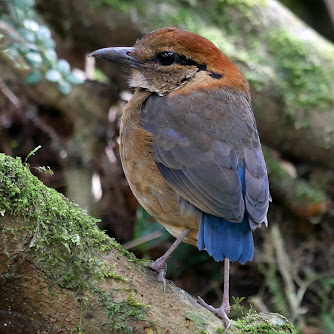
In the mid-story, the shadows are home to 9 species of Trogons—including the stunning Red-headed Trogon—while the forest floor belongs to the secretive Pittas. These 14 species of "forest jewels," such as the Mangrove Pitta and Garnet Pitta, share the leaf litter with over 20 species of Pheasants and Partridges, including the legendary Great Argus and the Malayan Peacock-Pheasant, famous for their intricate plumage and loud, echoing calls. The waterways and timber are managed by specialized hunters and engineers; 18 species of Kingfishers patrol the rivers, ranging from the jewel-like Oriental Dwarf Kingfisher to the massive Stork-billed Kingfisher. Deep within the trees, 28 species of Woodpeckers act as ecosystem engineers, carving out nesting cavities used by countless other forest creatures. As the sun sets, the rainforest undergoes a shift in guard to 25 species of Owls, such as the Buffy Fish-Owl and the formidable Barred Eagle-Owl. Together, these families represent the intricate balance of Malaysia’s natural heritage, making the country a world-class sanctuary for sustainable ecotourism and life on the wing.

Explore Malaysia


Search This Blog

Contact Form

Name

Email *

Message *

Instagram

Instagram
Follow me on instagram @malaysianbirder

Birds of Peninsular Malaysia

Birds of Peninsular Malaysia

Wildlife in Peninsular Malaysia

Wildlife in Peninsular Malaysia
A collection of wildlife photographs in Peninsular Malaysia that includes mammals, reptiles and amphibians. Some photographs are taken with camera while some are taken with mobile phone whenever I get the opportunities to shoot while on a guiding assignment.

Insects

Insects
You will see other interesting insects during your birding adventure with me. Here are some of the photos I have extracted from my hard drives..

Butterflies of Peninsular Malaysia

Butterflies of Peninsular Malaysia
Collection of photographs for reference.

Notable Plants While Birding

Notable Plants While Birding
There will be some interesting flora that will definitely catch your attention while going out on a birdwatching trip with me. I am in the midst of compiling all the plants, please return to this website for updates. Thank you.

Southeast Asia Birding

Southeast Asia Birding
Sometimes I accompany my regular guests for birding trips out of Peninsular Malaysia. Check out what we found.
Powered by Blogger.

Blog Archive

Total Pageviews

About Me

Hi! I love watching birds, taking photographs (and video), and guiding people through nature. Welcome to my blog, A Malaysian Birder. I'll be sharing all the great birds I see and the photos I take right here on this blog. I got into bird watching when I was in university studying parks and recreation management. I used to work in parks and gardens, teaching people about the environment and organizing birding walks. Whenever I go out to look for birds, I always bring my binoculars and spotting scope to help me see them up close. Sometimes, I even bring a microphone to record their calls. It's always an adventure out in the field!

Equipment Evolution

Equipment Evolution
In the past, I have used Kowa BDXD 8x32 binocular, Zoom H2N recorder, Kowa TSN-501 and my favorite Nikon1 V1 with a 70-300mm lens. This is the lightest setup I have tried and owned. From then onwards, I have used Omicron 8x26 binocular (and i bought 4 units), Leica Ultravid 8x32 binocular, Kowa Spotting Scope TSN773 with 20-60x eyepiece, Panasonic Lumix G7, Panasonic Lumix G9 with a 100-300mm lens and currently experimenting with Sony ILCE-A6700 and Sony SEL 200-600mm F5.6-6.3 G OSS lens.

Bird Watching Tours

There are quite a number of birding groups from Australia, United States and United Kingdom that come over to Malaysia annually visiting the traditional key sites that include Kuala Selangor, Fraser's Hill and Taman Negara. There is not doubt that the 3 sites are the preferred birding sites in Peninsular Malaysia. So if you are coming over for birding and intend to hire a guide, you can send me an email at nature2pixel@gmail.com and go over to posting section to view photos and summary of trip reports with testimonials from past clients.

Besides following the traditional route, I also customized trip according to clients needs, preference and interests. So there are some local patches that I can introduce to all bird watchers, digiscopers and photographers.

Here are a few of my favorite birding spots around Kuala Lumpur.

• Kuala Selangor - the habitats include mangrove forest. Good for woodpecker and kingfisher. Some amount of walking is required on flat terrain.

• Fraser's Hill - one of the traditional key sites for birding in Peninsular Malaysia and still the best place to visit. Elevation between 900 - 1200m above sea level. The species found here are different from the city of Kuala Lumpur. Targets may include Trogon, Woodpecker, Partridge, Laughingthrush, Leafbird, Spiderhunter and Sunbird.

• Hulu Langat - one of the most visited birding spot due to its proximity from the city centre. Walking is required but on easy terrain in this lowland forest. Sometimes need to wait at fruiting trees. Generally a good spot for Broadbill, Kingfisher, and Babbler.

• Bukit Tinggi - An alternative spot if you do not want to spend too long hours travelling to Fraser's Hill. It's about 900m to 1,000m above sea level and you get a combination of lowland and highland species at this elevation. Walking is required but just a short distance. Traditional known for Broadbill, Hornbill, Partridge and Pheasant.

• Gombak-Ampang - Generally recommended for photographers targeting Blue-eared Kingfisher and at times during fruiting season, it attracts many species of Bulbul and Barbet. Located in urban area.

Putrajaya - If you are staying in any hotel in Putrajaya, it's a good place to look for herons, egrets, bittern and storks.

Bird Families

Check the bird families and the taxonomy updates HERE.

My Artwork Products

Bird Video

I am also interested to take video of birds. Here are some of my favorite videos for your viewing. Video taken with Nikon1 V1 attached to a Sigma 500mm f4.5 and most of the time iPhone SE through the spotting scope. Editing is done on smartphone Power Director for Android device and I also like the iMovie on iPhone. Enjoy.

Recommended Field Guides & Books

If you are interested to get a copy of field guides to assist you to learn and identify birds in Malaysia. Click the followings to find out more.

March 2024. Fortunate enough to meet 1 of the authors before it was launched in Kuala Lumpur. Another great field guide for all birders who want to get the most updated information about birds of Malaysia.