Content

When the Forest Answers Differently - 21 Apr 2026


The forest dawn is an entirely separate world. For wildlife photographers, it’s a canvas of possibility, painted in cool mists and the first warming light. I had begun my morning elsewhere, chasing shadows and calls at dawn. It was a productive start, but a month of demanding assignments had kept me away from one of my favorite 'patches,' and a nagging thought pulled me towards Hulu Langat. Sometimes, the forest you know well calls you back.

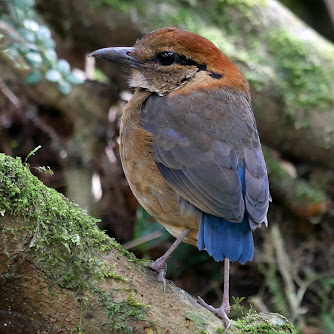
By midday, I was in position, deeply embedded in the Peninsular Malaysia rainforest undergrowth. My lens was focused, but not on my target. My target was the ultimate forest phantom: the Malayan Rail-babbler. This is not a bird you casually encounter; you negotiate with it. You wait. While a nearby individual was calling—that distinct, hollow whistle—it was not making an appearance. The silence of deep waiting ensued, broken only by the hum of the tropical humidity.

The Hulu Langat biodiversity is an ecosystem of constant distraction, and sometimes, those distractions are even grander than the target. Just as the Rail-babbler’s calls faded, a sound from the canopy shook the air: the thunderous flight calls of the mighty White-bellied Woodpecker, a pterodactyl-like presence in the Malaysian jungle. Moments later, a sharper, rattling call—an Orange-backed Woodpecker. This was too much potential to ignore.

I had a crucial decision: remain motionless for the ghost that might never show, or move for the definitive woodpeckers. I broke cover. Finding the woodpeckers was exhilarating, but they were high, fast, and uncooperative. The moment was electric, but I couldn’t manage to acquire focus for a single clean image. I lost the prize I was waiting for, and I lost the prize I chased.

I was back at square one, waiting for the forest to reset. But nature rarely follows our plans.

Instead of returning to wait for the Rail-babbler, three figures descended. It was a trio of Sooty Barbets. These are not the flamboyant, jewel-toned barbets of the high mountains; they are specialist residents of the lowland sub-canopy. Their beauty lies in their subtly: the rich, velvety, ash-brown plumage, the heavy, formidable bill, and the surprising flash of deep orange on their feet.

Initially, they were distant. But barbets are inquisitive. One eventually began a meticulous descent, moving from high perch to lower perch, investigating the area around me. This was the moment of quiet reward. The forest had offered a consolation prize that was, in itself, a perfect subject. It was calling, its heavy bill agape, perhaps vocalizing to the other two individuals still hidden in the leaves above.

This image, with its perfect green bokeh, is more than a species identification shot. It captures that momentary silence before the sky turned dark with storm clouds and forced me to pack. It represents the value of being present, of chasing every lead, and of having the humility to wait for the next offering. Hulu Langat birding is never just about one species. It’s an immersion in an ancient habitat where every encounter, from the rarest ghost to the local resident, tells a deep story.

Explore Malaysia


Search This Blog

Contact Form

Name

Email *

Message *

Instagram

Instagram
Follow me on instagram @malaysianbirder

Birds of Peninsular Malaysia

Birds of Peninsular Malaysia

Wildlife in Peninsular Malaysia

Wildlife in Peninsular Malaysia
A collection of wildlife photographs in Peninsular Malaysia that includes mammals, reptiles and amphibians. Some photographs are taken with camera while some are taken with mobile phone whenever I get the opportunities to shoot while on a guiding assignment.

Insects

Insects
You will see other interesting insects during your birding adventure with me. Here are some of the photos I have extracted from my hard drives..

Butterflies of Peninsular Malaysia

Butterflies of Peninsular Malaysia
Collection of photographs for reference.

Notable Plants While Birding

Notable Plants While Birding
There will be some interesting flora that will definitely catch your attention while going out on a birdwatching trip with me. I am in the midst of compiling all the plants, please return to this website for updates. Thank you.

Southeast Asia Birding

Southeast Asia Birding
Sometimes I accompany my regular guests for birding trips out of Peninsular Malaysia. Check out what we found.
Powered by Blogger.

Blog Archive

Total Pageviews

About Me

Hi! I love watching birds, taking photographs (and video), and guiding people through nature. Welcome to my blog, A Malaysian Birder. I'll be sharing all the great birds I see and the photos I take right here on this blog. I got into bird watching when I was in university studying parks and recreation management. I used to work in parks and gardens, teaching people about the environment and organizing birding walks. Whenever I go out to look for birds, I always bring my binoculars and spotting scope to help me see them up close. Sometimes, I even bring a microphone to record their calls. It's always an adventure out in the field!

Equipment Evolution

Equipment Evolution
In the past, I have used Kowa BDXD 8x32 binocular, Zoom H2N recorder, Kowa TSN-501 and my favorite Nikon1 V1 with a 70-300mm lens. This is the lightest setup I have tried and owned. From then onwards, I have used Omicron 8x26 binocular (and i bought 4 units), Leica Ultravid 8x32 binocular, Kowa Spotting Scope TSN773 with 20-60x eyepiece, Panasonic Lumix G7, Panasonic Lumix G9 with a 100-300mm lens and currently experimenting with Sony ILCE-A6700 and Sony SEL 200-600mm F5.6-6.3 G OSS lens.

Bird Watching Tours

There are quite a number of birding groups from Australia, United States and United Kingdom that come over to Malaysia annually visiting the traditional key sites that include Kuala Selangor, Fraser's Hill and Taman Negara. There is not doubt that the 3 sites are the preferred birding sites in Peninsular Malaysia. So if you are coming over for birding and intend to hire a guide, you can send me an email at nature2pixel@gmail.com and go over to posting section to view photos and summary of trip reports with testimonials from past clients.

Besides following the traditional route, I also customized trip according to clients needs, preference and interests. So there are some local patches that I can introduce to all bird watchers, digiscopers and photographers.

Here are a few of my favorite birding spots around Kuala Lumpur.

• Kuala Selangor - the habitats include mangrove forest. Good for woodpecker and kingfisher. Some amount of walking is required on flat terrain.

• Fraser's Hill - one of the traditional key sites for birding in Peninsular Malaysia and still the best place to visit. Elevation between 900 - 1200m above sea level. The species found here are different from the city of Kuala Lumpur. Targets may include Trogon, Woodpecker, Partridge, Laughingthrush, Leafbird, Spiderhunter and Sunbird.

• Hulu Langat - one of the most visited birding spot due to its proximity from the city centre. Walking is required but on easy terrain in this lowland forest. Sometimes need to wait at fruiting trees. Generally a good spot for Broadbill, Kingfisher, and Babbler.

• Bukit Tinggi - An alternative spot if you do not want to spend too long hours travelling to Fraser's Hill. It's about 900m to 1,000m above sea level and you get a combination of lowland and highland species at this elevation. Walking is required but just a short distance. Traditional known for Broadbill, Hornbill, Partridge and Pheasant.

• Gombak-Ampang - Generally recommended for photographers targeting Blue-eared Kingfisher and at times during fruiting season, it attracts many species of Bulbul and Barbet. Located in urban area.

Putrajaya - If you are staying in any hotel in Putrajaya, it's a good place to look for herons, egrets, bittern and storks.

Bird Families

Check the bird families and the taxonomy updates HERE.

My Artwork Products

Bird Video

I am also interested to take video of birds. Here are some of my favorite videos for your viewing. Video taken with Nikon1 V1 attached to a Sigma 500mm f4.5 and most of the time iPhone SE through the spotting scope. Editing is done on smartphone Power Director for Android device and I also like the iMovie on iPhone. Enjoy.

Recommended Field Guides & Books

If you are interested to get a copy of field guides to assist you to learn and identify birds in Malaysia. Click the followings to find out more.

March 2024. Fortunate enough to meet 1 of the authors before it was launched in Kuala Lumpur. Another great field guide for all birders who want to get the most updated information about birds of Malaysia.